
Back to Blog
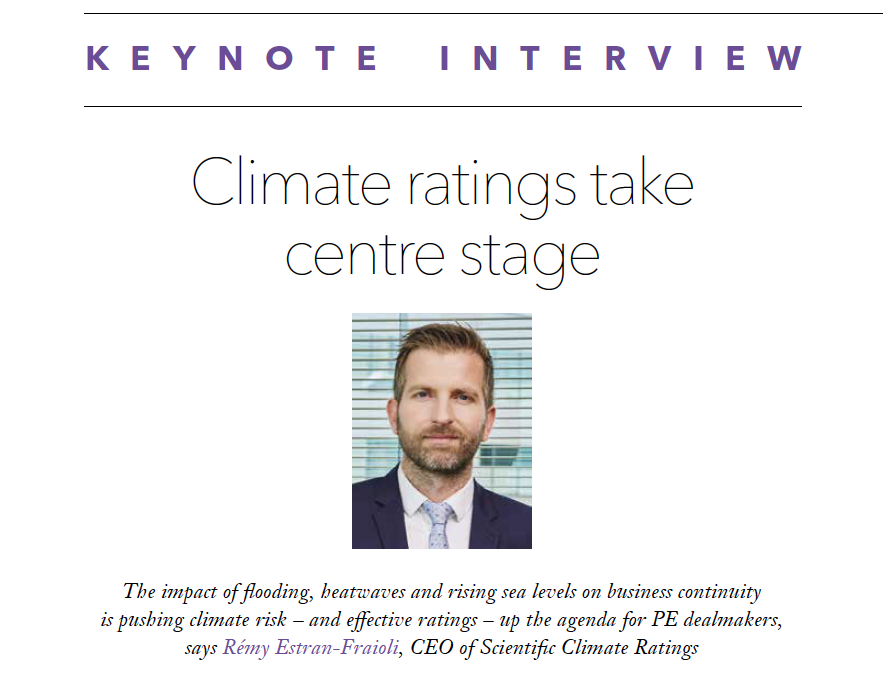
Keynote Interview with Rémy Estran-Fraioli, CEO of Scientific Climate Ratings, featured in the Responsible Investor report by Private Equity International.
The impact of flooding, heatwaves and rising sea levels on business continuity is pushing climate risk – and effective ratings – up the agenda for PE dealmakers, says Rémy Estran-Fraioli, CEO of Scientific Climate Ratings.
Q1: How is climate risk influencing how financial sponsors think about value creation and long-term return prospects? For a long time, value creation in private markets has come down to a mix of leverage, multiple expansion and operational improvement, but climate risk is now adding another dimension: adaptation, resilience and readiness for climate events. Financial sponsors are increasingly recognising that climate is not just a disclosure topic, but a driver of cashfl ow and exit multiples. Business models with high carbon emissions face very tangible pressures. The European cement industry, for example, is exposed to the cost of carbon via the emissions trading system, where the price per tonne of CO2 is around eight times the levels seen a decade ago. A carbon-intensive producer is therefore paying a substantially higher operating cost than a producer investing in decarbonisation. Similarly, on the physical side, climate is already disrupting companies and impacting asset value. The recent Texas floods and repeated California wildfires are real-life examples, as are the heat waves and floods observed in Southern Europe. These events translate directly into higher operational expenditure, higher plant capital expenditure, and lost revenue.
Q 2: What would you say are the most significant and material climate risks facing investors and companies? There are two main types of climate risk: energy transition risk and physical risk. The relative importance of each will change significantly from one location to another for physical risk, and from one sector and country to another for transition risk. The largest potential impact on earnings and valuations will be where the two risk areas overlap, such as around physical assets that are exposed to a physical hazard and also poorly positioned for energy transition.
Q 3: To what extent is climate risk affecting valuations, ability to raise debt and exit prospects over time? On the valuation side, as climate risk becomes better quantified, investors will price it in exactly the same way as any other risk to cashflows. For some assets, this will be a modest adjustment to growth or margin assumptions, but for others (consider heavy industry assets in highly exposed locations) it might be a double-digit hit to the equity value once you fully account for carbon costs, capital expenditure and a potential loss due to a change in consumer demand. With regards to debt, the reality is that climate risk doesn’t choose if it’ll hit the free cashflow to equity, or the cashflow available for debt servicing. Climate risk will impact the enterprise value and then, depending on the capital structure, it will either have the biggest impact on the equity or the debt. The tricky aspect here is that credit risk typically deteriorates gradually. Analysts can see it coming when revenues shrink or payments are missed. Climate risk rarely behaves so politely. When it comes to exits, it’s worth bearing in mind that the buyer universe is changing. Large asset managers, insurers and banks are under regulatory pressure to manage climate risk. That means assets with high emissions or physical climate risk exposure will attract a narrower buyer base and face difficult questions in due diligence. Assets that can evidence resilience and a credible transition plan will simply be more liquid in the end.
Q 4: How can independent climate ratings, grounded in climate science, be translated into financial numbers? And how might that help investors? The key is to bridge climate science and corporate fi nance. A rating provides much more than a score that is useful for benchmarking. All the data associated with the ratings are where the real value lies. Before coming up with the letter ratings, we quantify the impact of climate risk in terms of net asset value, and estimate the impact of climate on the top line and bottom line. The ratings data offers a clear line of sight from climate risk to earnings and value. Independent climate ratings are about quantifying exposure and vulnerability. In our case, for example, we start with objective data that reviews asset locations, emissions along the whole value chain, changing consumer demand, and the regulatory and legal backdrop. These reviews allow us to quantify how exposed a company or asset is to different energy transition pathways and physical drivers. The exposure and vulnerability risk drivers are then linked to revenues, operating costs, capital expenditure and cost of capital. We can model how different carbon price trajectories will affect EBITDA, how flood damage and downtime might affect cashflows, and what this all means for asset value. Finally, this can be aggregated into a rating that investors can use across their portfolios, in the same way that credit ratings are used in fixed income markets.
“The key is to bridge climate science and corporate finance”
Q 5: How are climate ratings different from more generalist ESG scoring? Climate ratings are anchored in the disciplines of engineering, financial modelling and robust climate science, and provide an asset-specific assessment of how an asset will react to different hazards, by modelling how an event of a given intensity will translate into physical damage. Those impacts are then integrated into standard corporate finance metrics. This makes climate ratings distinct from generic ESG scores, which often mix together a wide range of environmental, social and governance indicators, which are sometimes based on policies and disclosure rather than outcomes.
Q 6: How do you expect the climate ratings market to evolve over the next five years? I think the market is rapidly moving away from broad ESG scores and towards specialised climate risk analytics, with a clear link to financial metrics. If we want to steer capital towards a more resilient and sustainable future, we have to talk the language of investors. I also expect a shift from disclosure checklists to quantified financial materiality assessments. Over time, climate ratings will increasingly be integrated into mainstream investment credit and risk workflows, not just sustainability reporting processes. I think dealmakers and investors are less interested in emissions reporting methodologies, and much more focused on how climate risk translates into cashflows, asset values and cost of capital. Ideally, in five years’ time, climate rankings will be as standard a part of any investment discussion as credit ratings are in the bond market – no longer a niche accessory, but an essential tool for understanding risk and value.
Download a pdf format