
Back to Blog
Investing in asset-specific climate resilience strategies improves net asset value compared to business-as-usual operations.
A new report co-produced by the World Bank Group’s International Finance Corporation (IFC), AXA Climate, and Scientific Climate Ratings reveals a strong financial case for investing in targeted climate resilience strategies for infrastructure assets.
Published in June 2026, the Low Cost, High Yield: The Adaptation and Resilience Investment Opportunity for Infrastructure report analyses three Brazilian infrastructure assets across energy transmission and distribution, water supply and sanitation, and roads, evaluating how these real-world case studies could gain from targeted resilience investments. Scientific Climate Ratings led the quantitative analysis that underpins the paper’s findings. Leveraging our asset-level framework, we determined the most relevant and cost-effective resilience measures for each asset using the ClimaTech database. We were then able to conduct a cost-benefit analysis of implementing such measures, which uncovered the returns on the resilience investments and the impact on the net asset value (NAV).
The key findings 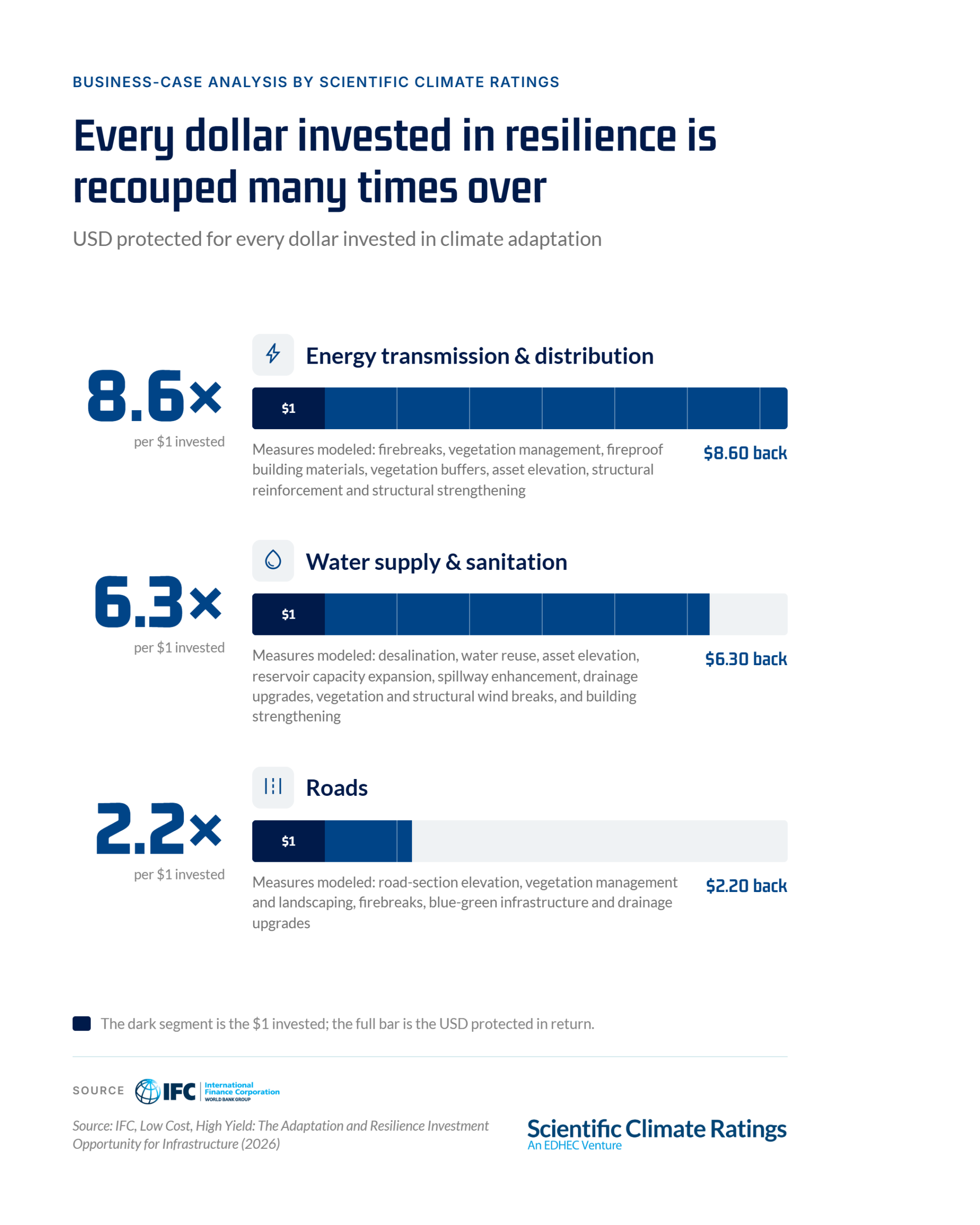
Figure 1. Returns on resilience investments for three sectors. Time Period: 2025 as the base year, 2026 as the first operational year, finishing in 2042 for the T&D case, and in 2050 for the other two assets. Scenario: high-emission.
The report states that the estimated average annual loss from extreme weather events impacting infrastructure and buildings already exceeds USD 700 billion. As the climate conditions intensify, physical damage to infrastructure assets and operational downtime could result in 43 million jobs lost across 49 countries by 2050.
However, the report also demonstrates that targeted adaptation and resilience investments can reverse this trajectory at a fraction of the cost of inaction. Across the three case studies (one of which is depicted in the figure below), the report found that investing less than 10 percent of asset value in resilience strategies delivers multiples of that cost in protected asset value. In addition, these strategies could reduce the projected job losses by more than half.
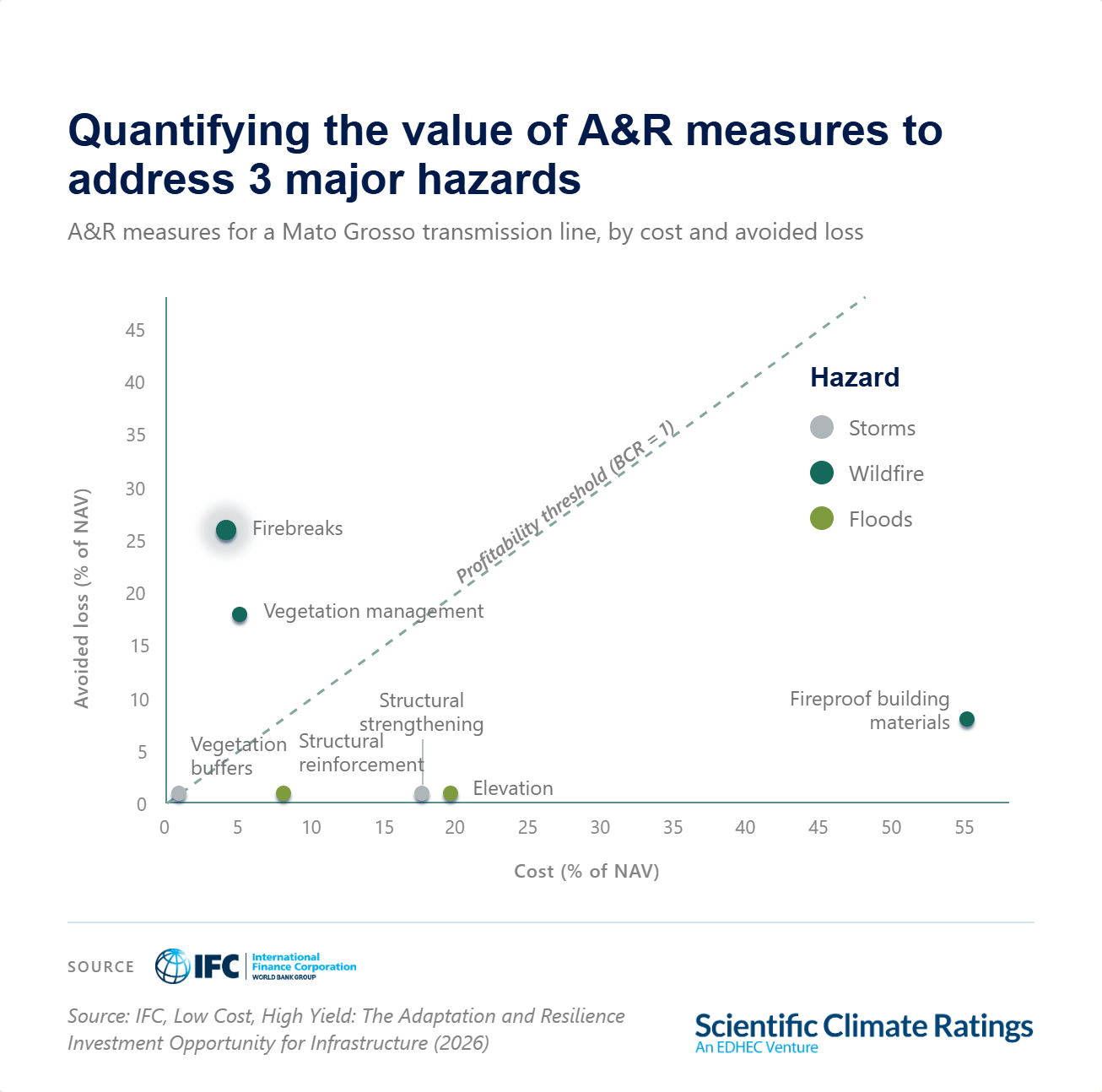
Figure 2. Cost against avoided loss analysis on adaptation and resilience measures relevant to the Mato Grosso transmission line. Time Period: 2025 as the base year, 2026 as the first operational year, finishing in 2042. Scenario: high-emission
Scientific Climate Ratings’ role
Scientific Climate Ratings developed the methodological approach and quantitative analysis used to evaluate the cost of adaptation measures, their effectiveness, and the cost-benefit ratios. This valuation framework is grounded in Scientific Climate Ratings’ proprietary infrastructure risk-adjusted performance metrics and investor-relevant financial modelling, which draws on the EDHEC Climate Institute’s ClimaTech database of over 1,800 decarbonisation and resilience strategies.
Compared to other methodologies that require extensive local data and customised analysis for each site, the methodology developed by Scientific Climate Ratings for this report offers a streamlined approach for faster screening across multiple assets. This approach can then be easily replicated and used by infrastructure operators’ finance and technical teams.
The report’s findings demonstrate what granular climate risk analysis makes possible: asset-specific investment decisions that are grounded in evidence, not assumptions. That is the standard that Scientific Climate Ratings applies to every rating we produce, and the standard the infrastructure investment community increasingly demands.
Download the full report here .