
Back to Blog

The SEC’s proposal to scrap mandatory climate disclosure is a political decision. The financial materiality of climate risk is not.
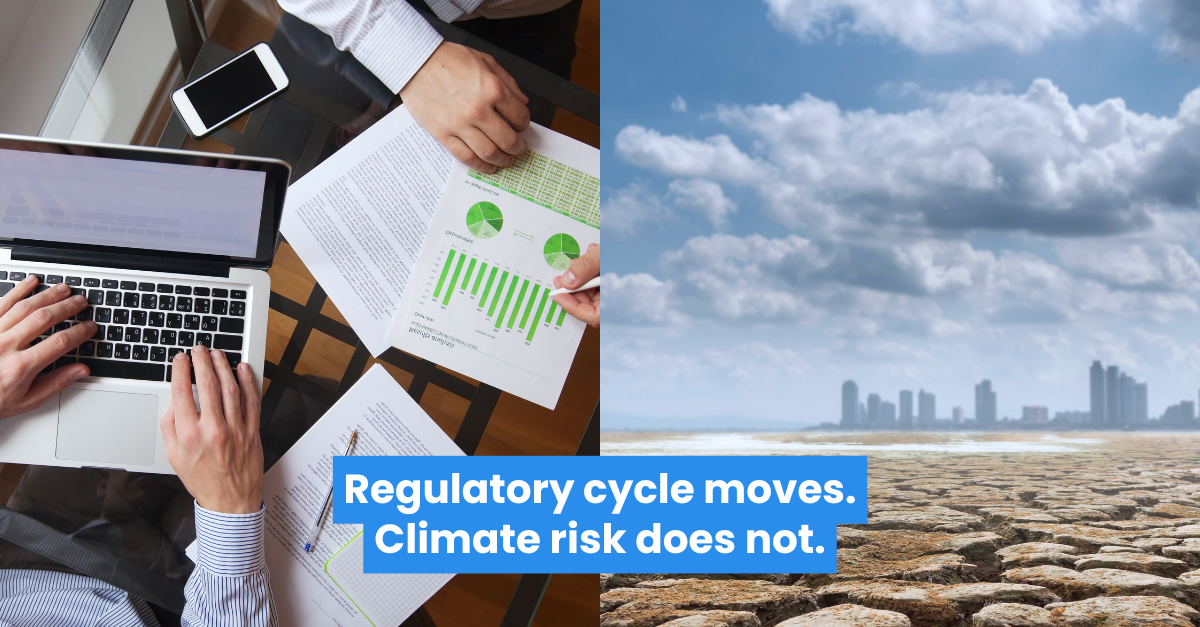
On 30 May 2026, the US Securities and Exchange Commission formally proposed to rescind its climate disclosure rules in their entirety, citing concerns about regulatory overreach and compliance burden. The rules, first finalised in March 2024 under the Biden administration, had already been suspended following legal challenges. Their formal withdrawal is now likely.
For investors tracking the regulatory landscape, this is a significant development. For investors trying to price climate risk, it changes very little.
The risk does not disappear when the reporting requirement does
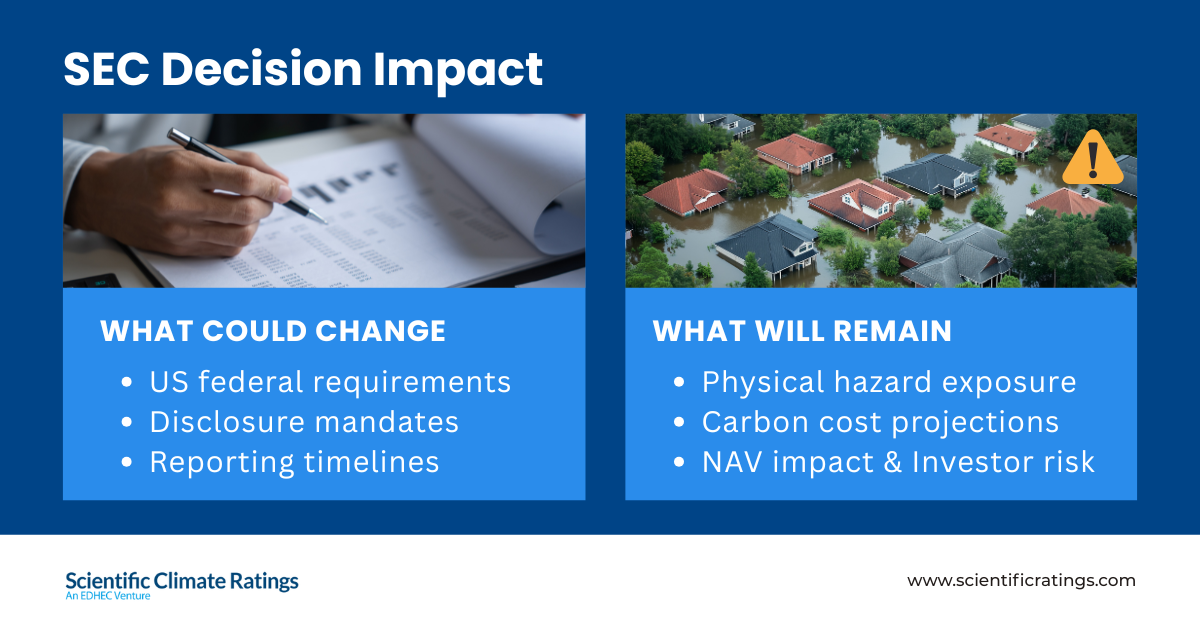
Physical and transition risks are not disclosure artefacts. They are financial facts.
Consider three examples, none of which require a disclosure mandate to be financially material:
- A retail or consumer goods company with manufacturing facilities concentrated in South and Southeast Asia faces escalating heat stress risk: higher workforce absenteeism, falling productivity, and revenue disruption that compounds year on year toward 2035.
- An automotive manufacturer with a carbon-intensive production base faces transition risk through rising carbon costs, regardless of whether those costs are reported. Under aggressive decarbonisation scenarios, the NAV impact of unmitigated Scope 1 and 2 emissions is measurable today.
- A real estate company with assets in flood-exposed urban corridors carries tangible asset loss probability that accrues independently of any reporting obligation.
These risks are not hypothetical. They are quantifiable, scenario-dependent, and already reflected in forward-looking financial models, including our own.
At Scientific Climate Ratings, we measure these risks directly.
- Our Climate Exposure Rating (CER) quantifies physical and transition exposure on an A-G scale, covering flood, storm, wildfire, and heat hazards, alongside carbon cost and market demand risk, across climate scenarios and time horizons.
- Our Climate Risk Rating (CRR) translates that exposure into financial terms, expressing climate risk as a direct percentage impact on Net Asset Value, scenario-weighted across multiple pathways.
- Neither rating depends on issuer disclosure. Both are grounded in climate science, geospatial data, and financial modelling.
When mandatory disclosure frameworks weaken, the burden on investors to source credible, independent climate risk data increases. Self-reported disclosures, even when mandatory, carry limitations: inconsistent methodologies, selective scope, and the well-documented gap between reported exposure and modelled financial impact.
Scientific Climate Ratings was built to address exactly this gap. Starting from one of the world’s largest financial datasets for infrastructure assets, we combine high-resolution geospatial data and proprietary physical risk models to deliver ratings grounded in climate science, not corporate self-reporting. That same methodology is now being extended to the corporate universe.
Expanding to corporate equities in 2026
The SEC’s withdrawal makes the case for independent corporate climate risk assessment more urgent.
In 2026, Scientific Climate Ratings is expanding coverage to 4,000+ listed equities, bringing consistent, forward-looking climate ratings to investors who can no longer rely on mandatory disclosure to do that work for them.
For investors who still need to understand climate risk in their equity portfolios (whether for capital allocation, risk pricing, portfolio construction, or their own regulatory obligations outside the US), this coverage will provide a consistent, comparable, and science-based input that does not depend on issuer disclosure.
Regulatory cycle moves. Climate risk does not.
Policy frameworks will continue to evolve – in the US, in Europe, and globally. What regulation cannot undo is the physical reality of climate hazards, which continue to intensify, or the financial logic of the transition to a low-carbon economy. Investors who anchor their climate risk assessment to regulatory requirements alone will find themselves exposed when those requirements shift.
Turning climate science into financial insights: that is the standard we hold ourselves to, and the one that investors deserve.