
Back to Blog
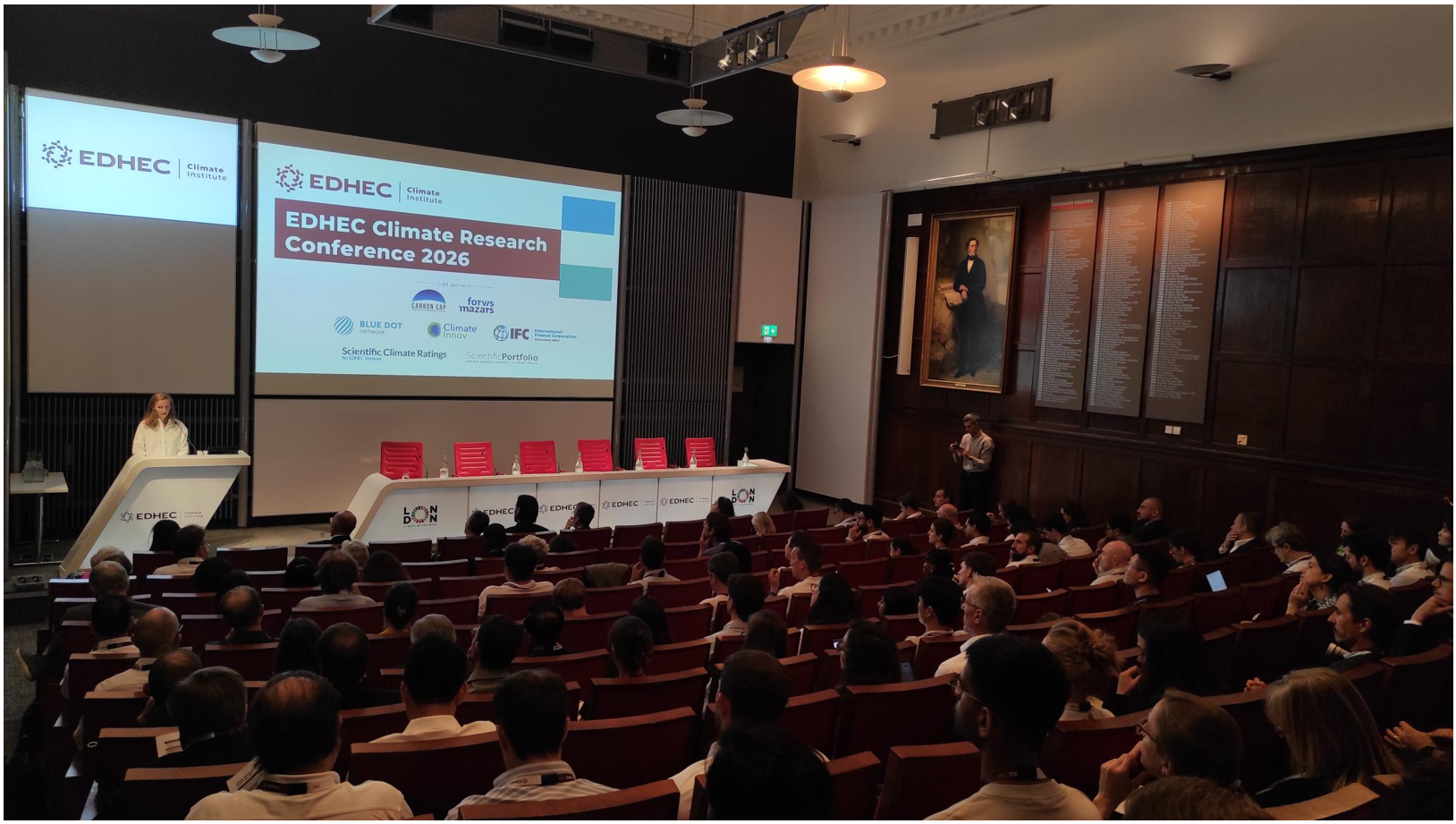
Expanded NGFS-aligned climate scenarios, asset-specific resilience strategies, and our new Sovereign Climate Risk Rating take centre stage at the EDHEC Climate Research Conference.
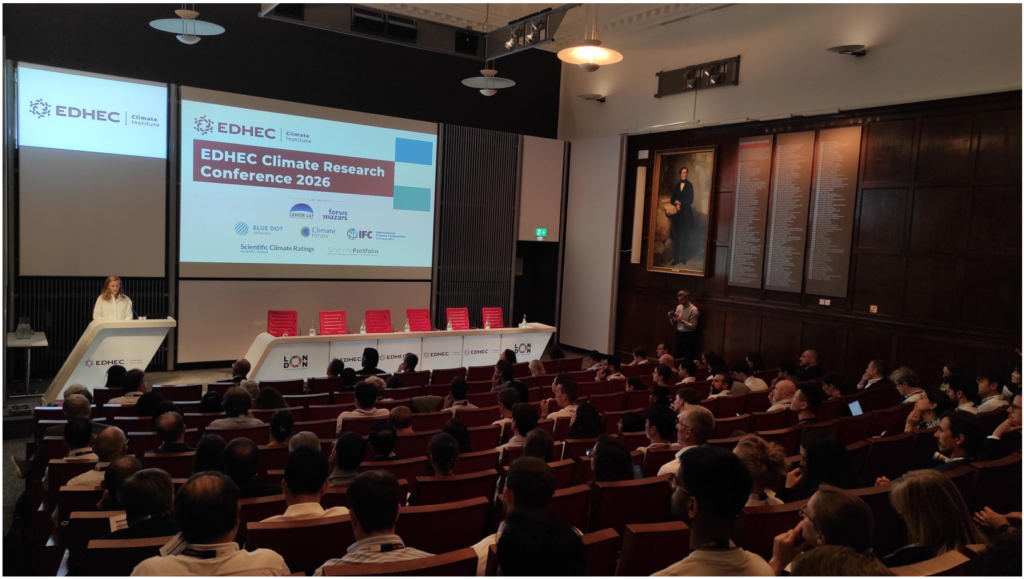
On 23 June 2026, the EDHEC Climate Institute (ECI) hosted its inaugural EDHEC Climate Research Conference, as part of London Climate Action Week.
Under the theme Climate Risk and Business Resilience: From Science to Strategic Action, the conference addressed a pressing challenge facing financial markets: how to move beyond simply recognising climate risks and begin measuring, pricing, and managing them. Through a combination of academic research, practical case studies, and product demonstrations, the event showcased how climate science can be translated into actionable financial insights.
The conference culminated with the launch of Scientific Climate Ratings’ new product: the Sovereign Climate Risk Rating (SovCRR). This framework, built on the ECI’s extensive climate finance research, is designed to quantify the expected economic impact of chronic climate change across sovereign economies.
As the Dean of the EDHEC Business School, Emmanuel Metais, shared in his opening remarks, “Climate change is an economic, technological, social, and scientific issue, and no one discipline alone can address it.” This was evident throughout the conference, and attendees left the event with a wealth of tools and resources to cover climate risk from all angles.
One such resource is Scientific Climate Ratings, which translates this science into decision-grade insight for investors.
Climate scenarios underpin climate action
Professor Riccardo Rebonato and Associate Researcher Lionel Melin began the day by presenting their research on climate scenarios. They outlined how these scenarios are essential for building a climate narrative, but they are most useful for stakeholders when they are comprehensive and assigned probabilities.
To address this need, Lionel Melin shared how the ECI’s dedicated climate scenarios team is working to expand the scope of NGFS climate scenarios with two additional high-emission pathways: Climate Destabilisation and Climate Breakdown. These scenarios extend the established NGFS framework, ensuring that decision-makers can assess a full range of potential climate outcomes and future-proof their assets even in a worst-case scenario.
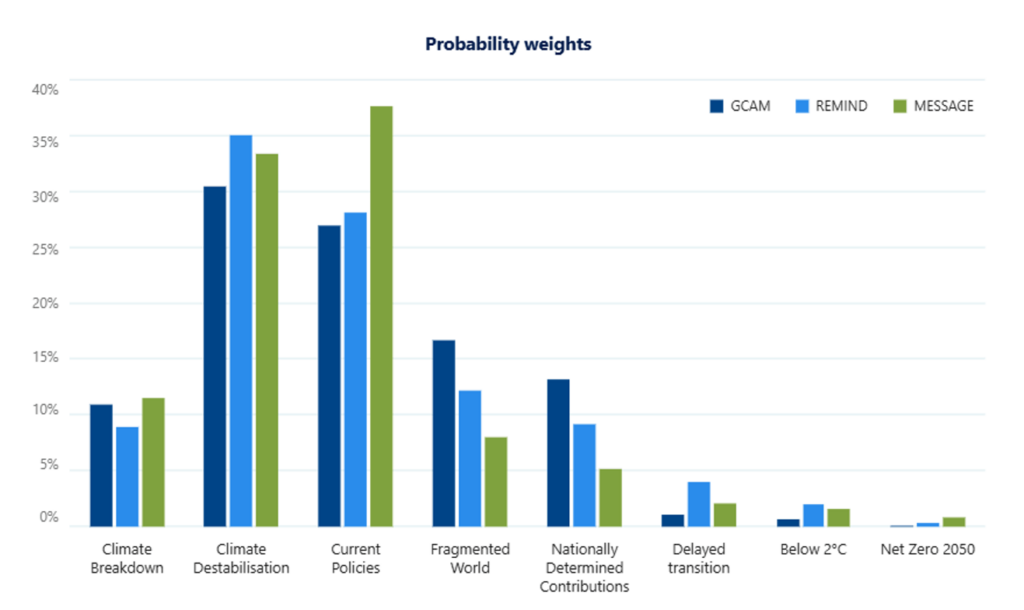
Figure 1. Probability weights per Integrated Assessment Models (IAMs) of the NGFS climate scenarios, plus two ECI-developed scenarios. Source: EDHEC Climate Institute. GCAM: Global Change Assessment Model, REMIND: Regional Model of Investments and Development, MESSAGE: Model for Energy Supply Strategy Alternatives and their General Environmental Impact.
From temperature to economic damages: why granularity matters
Having established a foundation of comprehensive climate scenarios, the conference examined how these pathways may translate into macroeconomic damages.
Nicolas Schneider, Senior Research Engineer (ECI) and key contributor to Scientific Climate Ratings’ methodologies, spoke of how advances in climate science, geospatial modelling, and economics are enabling increasingly granular assessments of physical climate risk. Rather than relying on national averages, these approaches examine impacts across regions and industries, revealing significant variations that are often hidden in aggregated analyses. Critically, he showed that sector-specific damage trajectories are largely heterogeneous.
Decomposing macroeconomic impacts across time, space, and sectors therefore provides asset owners with a more useful picture than national or global averages; this granularity is at the heart of Scientific Climate Ratings’ offerings.
Transition risk is more than just carbon pricing

ANTHONY SCHRAPFFER
CHIEF SCIENTIFIC OFFICER
SCIENTIFIC CLIMATE RATINGS
SCIENTIFIC CLIMATE RATINGS
Transition risk also featured prominently across the sessions. Keynote speakers set the scene, sharing an overview of the history of emission trading systems and the potential future of the carbon market as it continues to scale.
Scientific Climate Ratings’ Chief Scientific Officer, Anthony Schrapffer, then took to the stage to discuss the importance of a multi-factor approach that captures the full spectrum of transition risk. Beyond carbon pricing, infrastructure assets are also vulnerable to policy volatility, geopolitical tension, and demand shifts. For this reason, Scientific Climate Ratings consults the climate regulation and policy branch of the ECI’s research to develop a holistic transition risk framework beyond simply quantifying and pricing an asset’s Scope 1, 2, and 3 emissions.
Facilitating smart climate management through resilience and decarbonisation insights

NISHTHA MANOCHA
CHIEF OPERATING OFFICER
SCIENTIFIC CLIMATE RATINGS
SCIENTIFIC CLIMATE RATINGS
In the session on the ClimaTech database, Scientific Climate Ratings’ Chief Operating Officer Nishtha Manocha shared some striking statistics. A poll of investors revealed a significant gap between their awareness of climate risks and their ability to react to them.
Investor sentiment
—
Physical climate risk
—
Physical climate risk
97%
believe that physical climate risk is significant
76%
anticipate a medium or high impact of climate risk on their infrastructure investments
16%
believe that there is adequate understanding of how physical climate risk will affect infrastructure assets
Figure 2. Investor survey conducted by the EDHEC Infrastructure & Private Assets Research Institute, January 2024.
Leveraging ECI’s ClimaTech database of over 1,800 resilience and decarbonisation measures, Scientific Climate Ratings is addressing this lack of decision-grade resources.
We consult this database to determine the most cost-effective and relevant strategies for individual assets. We can then model how these strategies will impact an asset’s net value compared to business-as-usual operations, to help asset owners and managers justify investment in such measures where there is a strong financial case.
Case study: rating the Angololo Water Resources Development Project
The conference showcased practical applications of Scientific Climate Ratings’ Climate Exposure and Climate Risk Ratings through the real-world case study of the Angololo Water Resources Development Project, which includes a dam, mini hydropower plant, and irrigation network. Scientific Climate Ratings was able to offer a comprehensive climate risk assessment to complement the project’s Blue Dot certification. We assigned a ‘B’ Climate Exposure Rating (2035 and 2050), against a peer median of ‘F’, owing to the project’s robust physical design and six embedded resilience measures against heat and wildfires. By showing the project to be one of the least-exposed assets of its class, the asset managers can continue to justify investment in resilience.
“The Climate Exposure Rating is a diagnosis of a project’s weak points, and the Climate Risk Rating is a financial prescription.”
Mariya Peykova, Sales Director at Scientific Climate Ratings
Unveiling the Sovereign Climate Risk Rating

ALEXIS DE PAMPELONNE
CLIMATE RISK MANAGER
SCIENTIFIC CLIMATE RATINGS
SCIENTIFIC CLIMATE RATINGS

NICOLAS SCHNEIDER
SENIOR RESEARCH ENGINEER
EDHEC CLIMATE INSTITUTE
EDHEC CLIMATE INSTITUTE
To close the conference, Alexis de Pampelonne, Climate Risk Manager, and Nicolas Schneider, Senior Research Engineer (EDHEC Climate Institute) unveiled Scientific Climate Ratings’ newest product: the Sovereign Climate Risk Rating (SovCRR).
The SovCRR is a scientific standard for understanding and pricing the macroeconomic impact of rising temperatures on sovereign economies. Based on the academic research and expertise of the ECI and the in-depth market insights of Scientific Climate Ratings’ established products, Sovereign Climate Risk Ratings capture the winners and losers in a future global economy where the effects of chronic physical climate risk have real and lasting impacts on gross domestic product. Read the full press release for more detail: Press Release.
Figure 3. Overview of the SovCRR methodology and coverage
Assessing climate risk at the sovereign level reveals three key findings:
- Expected gross regional product per capita impacts follow a pronounced latitude gradient.
High-latitude regions see limited losses or even modest gains, while losses deepen toward the tropics.
- Internal heterogeneity is not diversification.
The impact curve is concave: gains from warming in cold regions are smaller than losses from equivalent warming in hot regions. Optimum productivity sits at 13 °C.
- Projected impacts across all nine scenarios remain within a narrow band through 2035, then fan out sharply after 2050.
Near-term ratings are driven by physical structure, while mid-century ratings depend materially on which climate pathway unfolds.
The SovCRR is just another example of how the research produced by the EDHEC ecosystem is being leveraged to address gaps in market intelligence and drive decision-grade insights for stakeholders.
Bridging the gap between climate science and financial decisions
The inaugural EDHEC Climate Research Conference demonstrated what happens when rigorous applied research meets the on-the-ground demands of decision makers. The work of the ECI is not merely an academic endeavour; it empowers the decision-grade ratings and analytics that Scientific Climate Ratings delivers to investors every day.
Bringing together researchers, investors, policymakers, and industry stakeholders, the sessions converged on a central message: climate risk is a present-day financial reality that must be measured, priced, and managed. Scientific Climate Ratings exists to make that possible, translating the science produced by the ECI into investment intelligence that helps asset managers and owners get ahead of the curve on climate change.
Quick check
How many sub-national regions does the Sovereign Climate Risk Rating cover?